Mechanical Entrainment in Textile Floor Covering Cleaning
Intro Summary
This article explains mechanical entrainment© as a distinct and often overlooked soil extraction mechanism in textile floor covering cleaning. While industry standards clearly define air and water as soil transport methods, they frequently misclassify mechanical entrainment as mere agitation. This piece clarifies what mechanical entrainment is, how it functions at the fiber–soil interface, and why formally recognizing it is necessary for accurate standards, effective maintenance planning, and reduced reliance on unnecessary water-based cleaning.
The Missing Extraction Mechanism in Modern Maintenance Standards
Modern carpet maintenance standards accurately describe air (vacuuming) and water (rinse extraction) as primary soil removal mechanisms, but they fail to formally recognize mechanical entrainment as a third, independent extraction method.
For decades, professional carpet cleaning standards have described the roles of air and water as soil transport mechanisms. However, mechanical entrainment© has remained underdefined, inconsistently classified, or relegated to the category of “agitation.” Its omission limits the accuracy of maintenance standards and constrains how effective real-world cleaning systems are described and evaluated.
What Mechanical Entrainment Is – and Is Not

Mechanical entrainment refers to the physical dislodgement, capture, and removal of soils from within the carpet pile through controlled mechanical action, independent of air or liquid transport.
This distinction matters because it defines mechanical action as an extraction mechanism, not merely a preparatory step.
Mechanical entrainment is not simply agitation.
- Agitation describes motion applied to fibers or soils.
- Entrainment describes soil capture and transport.
Mechanical entrainment occurs when mechanical energy dislodges, separates, and physically removes soils from within the carpet pile structure through controlled contact and motion, without relying on airflow or liquid transport as the primary carrier.
Soil States Demand Different Transport Mechanisms
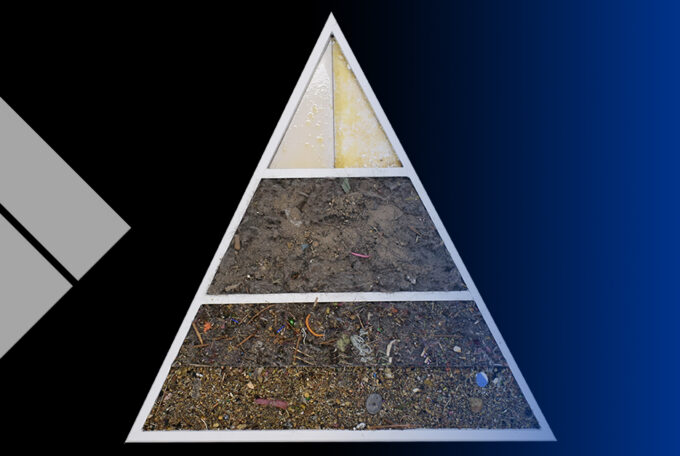
Carpet soils fall into three functional categories based on how they are transported and removed:
- Loose dry particulate (managed by air entrainment)
- Soluble and semi-soluble residues (managed by chemical suspension and water transport)
- Entangled, trapped, and embedded dry insoluble particulate
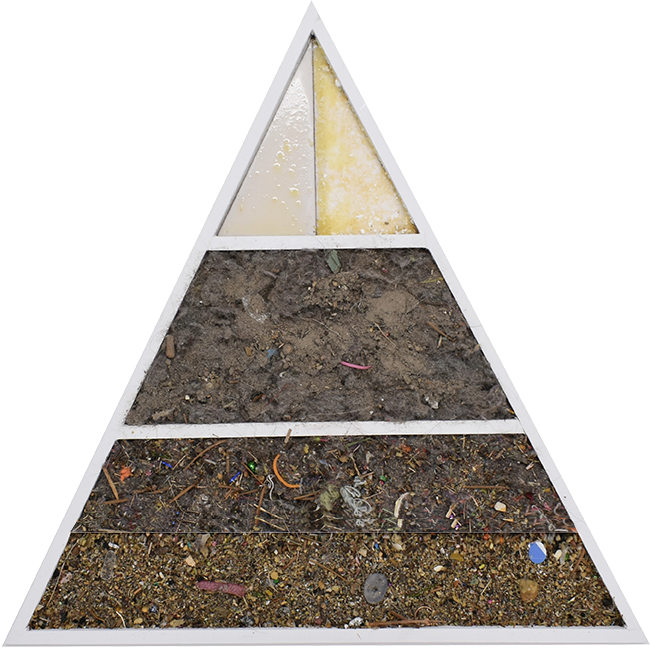
It is this third category, entangled, trapped, and embedded dry insoluble soil, that mechanical entrainment addresses more effectively than either air or water alone.
Air Entrainment Limitation
Vacuum airflow is highly effective on loose particulate but lacks sufficient shear force to overcome fiber occlusion once soils become entangled, compacted, or embedded within the pile structure.
Water Entrainment Limitation
Water dissolves soluble soils but does not reliably extract embedded mineral particulate and may increase occlusion or soil migration into backing layers when dry soils are not addressed first.
Mechanical entrainment operates directly at the fiber–soil interface, where neither air nor water is most effective.
The Physics of Mechanical Entrainment
Mechanical entrainment functions physically by applying controlled mechanical energy that directly dislodges and removes embedded particulate from within the carpet pile.
It operates through three concurrent actions:
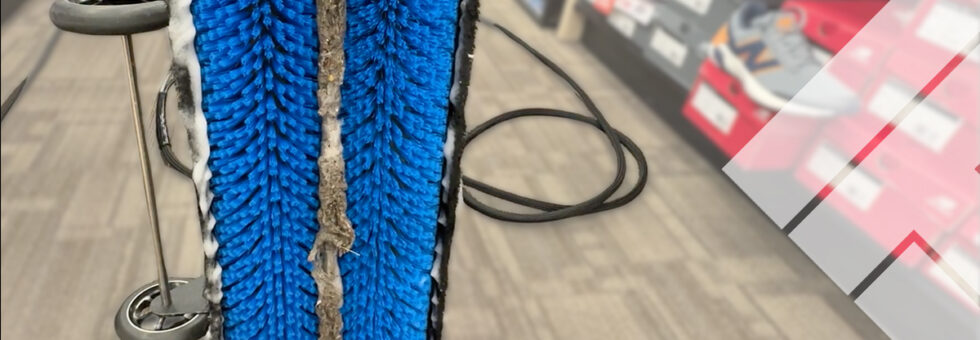
- Fiber Separation and Pile Opening – This action increases effective pore space within the pile. Counter-rotating or cylindrical brush systems temporarily separate yarns and filaments, reducing occlusion and restoring airflow and chemical access.
- Soil Dislodgement via Shear and Counter-Motion – This action overcomes binding and compaction forces. Opposing brush rotation creates shear forces that overcome van der Waals bonding, micro- and macro-occlusion, and compaction from foot traffic. This is fundamentally different from horizontal rotary, oscillation, or single-direction brushing.
- Immediate Mechanical Extraction – This action results in direct particulate removal. Dislodged soils are physically lifted and transported into collection trays, vacuum chambers, or forward migration zones without requiring suspension in air or liquid. This is extraction, not preparation.
Why Mechanical Entrainment Is Not Redundant
Mechanical entrainment is sometimes dismissed as unnecessary based on two common objections.
- Common objection 1: “Vacuuming already removes dry soil.”
- Common objection 2 “Water extraction will flush it out.”
Both assumptions fail under real-world conditions.
Vacuuming Limitation
Vacuuming performs well on loose particulate but rapidly diminishes in effectiveness once soils are entangled, compressed, or coated with binding agents.
Water Extraction Limitation
Water mobilizes soluble soils but does not dissolve mineral particulate, does not reliably transport large or dense particles, and may increase soil migration into backing layers if dry soil is not addressed first.
Mechanical entrainment fills this functional gap.
How Encapsulation Systems Revealed Mechanical Entrainment
Encapsulation systems revealed the importance of mechanical entrainment because their effectiveness depended on mechanical extraction rather than chemistry alone.
Encapsulation did not succeed because of chemistry by itself. It succeeded because chemistry was paired with mechanical entrainment, allowing:
- controlled soil suspension,
- effective dislodgement,
- and deferred extraction through routine vacuuming.
This was not a new cleaning principle. It was a rebalancing of soil transport mechanisms.
Why “Agitation” Is an Inadequate Term
Labeling mechanical entrainment as agitation creates three problems:
- It obscures the extraction function, which leads to misclassification of effective systems.
- It prevents accurate comparison of cleaning methods, resulting in method bias.
- It discourages optimization of mechanical design, limiting system performance.
Agitation is a means.
Entrainment is an outcome.
Standards should describe outcomes.
Mechanical Entrainment as a Standalone Principle
A primary cleaning mechanism is defined by its ability to independently remove soil through a distinct physical process.
Mechanical entrainment meets this criteria:
- It independently removes soil
- It targets a distinct soil state
- It produces measurable extraction
- It alters system performance outcomes
As such, it should be recognized alongside:
- air entrainment (vacuuming)
- water entrainment (rinsing or flushing)
Implications for Standards and Maintenance Programs
When mechanical entrainment is recognized:
- Standards accurately describe real-world cleaning systems
- Method bias is reduced
- Maintenance planning improves
- Unnecessary water usage is reduced
- Carpet service life is extended
- Cleaning definitions align with soil physics
When mechanical entrainment is not recognized:
- Effective systems are misclassified
- Water-based interventions are overused
- Restorative cleaning is escalated prematurely
Proposed Standards Language
Proposed definition for standards use:
“Mechanical entrainment refers to the physical dislodgement and removal of embedded dry insoluble soils through controlled mechanical action, independent of air or liquid transport, and may be employed as a primary or complementary extraction mechanism within textile floor covering cleaning systems.”
This language does not favor equipment or brands. It favors accuracy.
Conclusion
Mechanical entrainment is not new, but its formal recognition is overdue.
When soil removal mechanisms are correctly identified and classified, maintenance systems become clearer, more efficient, and more defensible scientifically and operationally.
Standards do not need to invent mechanical entrainment. They need only to acknowledge what is already occurring in the field.