The Entrainment Trifecta: Air, Mechanical, and Water
A Unified Model for Commercial Carpet Cleaning and Maintenance
Intro Summary
This article introduces the Entrainment Trifecta©, a unified model for commercial carpet cleaning that explains how soil is actually removed from textile floor coverings. It clarifies the distinct roles of air, mechanical, and water entrainment, showing how each mechanism addresses different soil states and why no single method is sufficient on its own. By reframing cleaning as coordinated entrainment rather than competing methods, the article provides a clearer framework for building effective, efficient, and sustainable carpet maintenance programs.
The Entrainment Trifecta

The Entrainment Trifecta is a cleaning framework that defines soil removal as the coordinated use of air, mechanical, and water entrainment, each addressing different soil states within a carpet system.
Modern commercial carpet maintenance has advanced significantly in equipment, chemistry, and scheduling. Yet much of the industry still operates within an incomplete mental model that recognizes air and water as cleaning forces while underestimating or misclassifying mechanical entrainment.
Together, air, mechanical, and water entrainment explain how soil actually leaves textile floor coverings and why no single method, used in isolation, can deliver optimal performance over time.
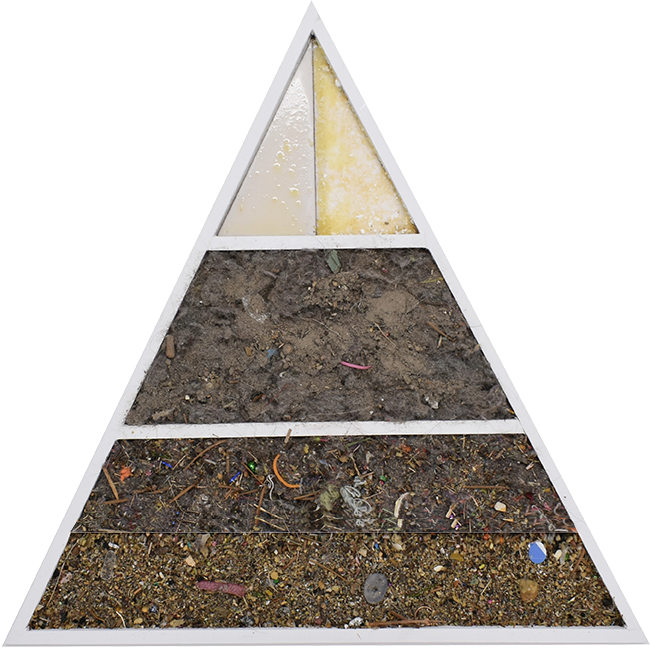
Cleaning is Entrainment
Cleaning is the controlled mobilization and removal of unwanted matter from a system.
For soil to be removed from a carpet system, three conditions must be met:
- Soil must be dislodged from fibers
- Soil must be captured or suspended
- Soil must be transported out of the usable environment
Entrainment is the mechanism that makes this process possible.
Air, mechanical action, and water are not competing philosophies. They are complementary transport mechanisms, each optimized for different soil states.
In practice, each entrainment mechanism serves a distinct function:
- Air entrainment manages loose particulate
- Mechanical entrainment liberates embedded particulate
- Water entrainment removes soluble and binding residues
1. Air Entrainment (Vacuuming)
Air entrainment primarily removes dry, loose, and free-standing insoluble soils from carpet surfaces.
Primary role:
Removal of dry, loose, and free-standing insoluble soils.
Air entrainment is the foundation of all effective carpet maintenance programs. It removes the majority of tracked and settled particulate matter before it becomes embedded, abrasive, or chemically bound.
Strengths:
This results in effective routine soil control with minimal risk.
- Highly effective on loose particulate soils
- Lowest risk to fibers and backing
- Essential for health-based soil management
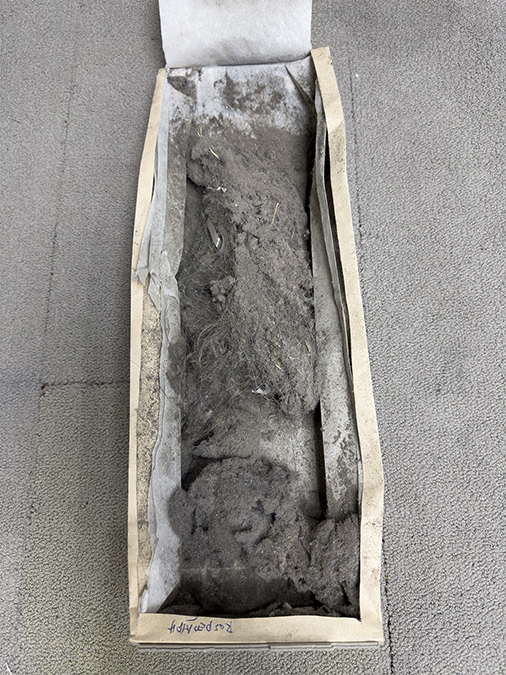
Limitations:
Air entrainment is ineffective when soils become:
- entangled, trapped, and embedded particles
- compacted soils
- sticky or chemically bound residues
Air alone cannot overcome occlusion within the pile structure.
2. Mechanical Entrainment (Quasi-Fluid Extraction)
Mechanical entrainment primarily dislodges and extracts entangled, trapped, and embedded dry insoluble soils.
Primary role:
Dislodging and extracting entangled, trapped, and embedded dry insoluble soils.
Mechanical entrainment refers to the physical dislodgement and removal of dry particulate soils through controlled mechanical action, independent of air or liquid transport.
It has long been mislabeled as “agitation.” In reality, it performs two functions:
- Soil disruption and dislodgement
- Immediate mechanical extraction of released dry soils
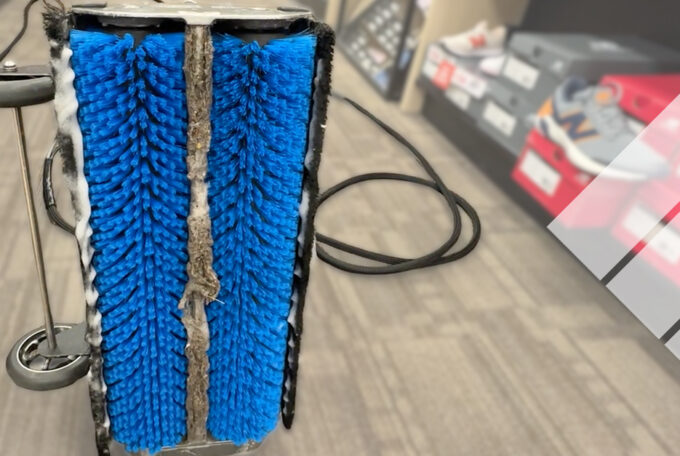
Counter-rotating brush (CRB) machines, powered pile lifters, and cylindrical brush systems create quasi-fluid movement within the pile, allowing particles to be lifted, separated, and removed in ways air and water alone cannot achieve.
This is not theoretical. It is observable in recovered soil volume.
Strengths:
This results in improved removal of damaging particulate and improved pile condition.
- Removes abrasive particulate vacuuming misses
- Restores pile openness and resiliency
- Enhances chemical distribution when chemistry is used
- Reduces dependence on water volume
Limitations:
- Not designed to dissolve or flush soluble soils
- Must be paired with chemistry or follow-up extraction where binding agents exist
Mechanical entrainment functions as the bridge between air and water.
3. Water Entrainment (Rinse and Flush Extraction)
Water entrainment primarily dissolves, suspends, and transports soluble soils and binding agents.
Primary role:
Dissolving, suspending, and transporting soluble soils and residues.
Water is unmatched when it comes to:
- Dissolving salts, sugars, and residues
- Flushing suspended contaminants
- Resetting heavily impacted areas when used appropriately
Strengths:
This results in effective removal of soluble and sticky residues.
- Best tool for soluble soils
- Effective for high-load food service environments
- Essential in most corrective or restorative scenarios
Limitations:
- Limited effectiveness on dry insoluble particulate
- Increased risk when overused or misapplied
- Logistical constraints in many commercial buildings
Water is powerful, but it is not complete on its own.
Why the Entrainment Trifecta Matters
Understanding the Entrainment Trifecta changes how carpet maintenance programs are designed and evaluated.
Industry confusion arose when cleaning methods were framed as either-or choices rather than coordinated mechanisms.
In reality:
- Air manages loose particulate
- Mechanical liberates embedded particulate
- Water removes soluble and binding residues
Each addresses a different soil state.
No method replaces the others. Each becomes more effective when the others are used correctly.
Encapsulation: A Practical Example of the Trifecta at Work
Encapsulation systems are a practical example of the Trifecta because they integrate chemistry with mechanical entrainment while deferring final soil removal to air.
Encapsulation systems succeeded not because they eliminated water, but because they optimized how and when water was used.
Encapsulation:
- Softens and suspends soils chemically
- Relies on mechanical entrainment for release
- Defers final air entrainment (vacuuming) for removal
This bundled approach reduced moisture dependency while improving overall soil control in commercial settings.
It did not replace water. It optimized its role.
Reframing "Deep Cleaning"
Depth of cleaning is defined by which soil layers are addressed, not by moisture volume or equipment type.
Depth is not defined by:
- Moisture volume
- Extraction noise
- Visual wastewater contrast
A program that routinely manages:
- Dry insoluble soils through air and mechanical entrainment
- Soluble soils through chemistry and water as needed
Can maintain carpet indefinitely without cyclical degradation.
The Corrective Takeaway
Effective commercial carpet maintenance depends on applying the correct entrainment mechanism at the correct time for the correct soil state.
When air, mechanical, and water entrainment are understood as a unified system:
- Maintenance programs become predictable
- Carpet life is extended
- Health outcomes improve
- Restorative cleaning becomes the exception, not the expectation
Conclusion
The Entrainment Trifecta provides a complete and accurate model for how soil leaves a carpet system.
When cleaning strategies are built around coordinated entrainment rather than isolated methods, performance improves while risk and resource waste decline.
“Sustainable carpet care does not depend on more water or less water. It depends on understanding how soil actually leaves the system.”