What is “Interim” Cleaning?
Clarifying the Interim Cleaning Strategy in Commercial Carpet Care
Intro Summary
This article clarifies what “Interim Cleaning” actually means in commercial carpet care and why the term is often misunderstood. It explains interim cleaning as a strategy defined by purpose and intensity, not by specific methods, moisture levels, or equipment. By distinguishing interim cleaning from routine and restorative strategies and tying each to the soil types they address, the article provides a clearer, more accurate framework for designing effective commercial carpet maintenance programs.
What Interim Cleaning Is

Interim cleaning is the strategy used to manage soluble soils and binding agents in commercial carpet between routine and restorative cleaning cycles.
Few terms in commercial carpet care are as widely used, and as widely misunderstood, as “Interim Cleaning.” Over time, the term has accumulated assumptions that were never part of its original intent, including the belief that it is maintenance rather than cleaning, that it is less effective than water rinse extraction, or that it is limited to low-moisture methods.
None of those interpretations are technically correct.
Interim Cleaning is a Strategy, not a Method
Interim cleaning is defined by its purpose and scope, not by the tools, moisture levels, or chemistry used to perform it.
In commercial textile floor care, maintenance strategies exist to address different soil types and accumulation rates. Routine, Interim, and Restorative cleaning are complementary components of a complete system, not competing approaches.
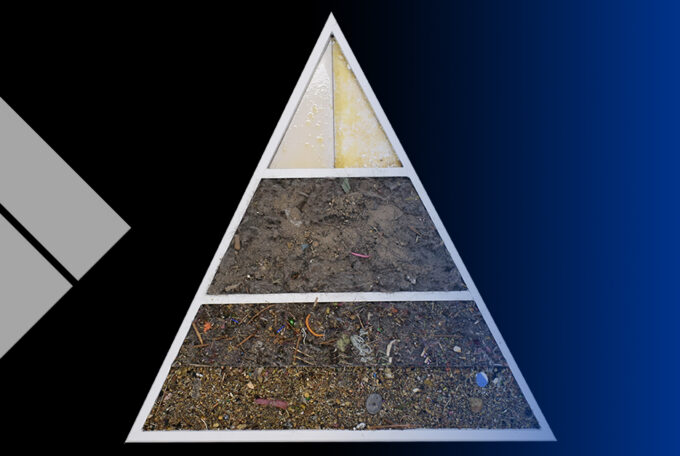
Commercial carpet maintenance relies on three coordinated strategies:
- Routine cleaning for dry insoluble soils
- Interim cleaning for soluble soils and binding agents
- Restorative cleaning for recovery when normal maintenance capacity has been exceeded
Routine Cleaning: Managing Dry Insoluble Soils
Routine cleaning exists to prevent performance loss by controlling dry, insoluble soils before they accumulate to damaging levels.
Routine cleaning includes:
- Frequent vacuuming (air entrainment)
- Periodic pile lifting or pile brushing (mechanical entrainment©)
- Timely spot, spill, and stain removal
When performed correctly and at appropriate frequencies, routine cleaning removes the majority of dry particulate soils and preserves carpet resiliency, appearance, and service life.
If routine cleaning is effective, what remains is not bulk soil. It is something else.
Why Interim Cleaning Exists
Interim cleaning exists because routine cleaning does not address soluble soils.
Dry soil management alone cannot control moisture-borne residues, oils, and other binding agents that accumulate differently than particulate matter.
What Interim Cleaning Actually Addresses
Interim cleaning is designed to manage soluble soils, also referred to as binding agents or “sticky soils.”
Soluble soils managed by interim cleaning include:
- Moisture tracked in from weather
- Cooking oils and food aerosols
- Sugars, salts, and residues from food and drink
- Other water-soluble contaminants that accumulate independently of dry soil
These soils are not reliably controlled by routine vacuuming or pile lifting alone, even when those processes are performed well.
When soluble soils accumulate, they cause the following effects:
- Attraction of fine particulate soils
- Dulling of carpet appearance
- Reduced effectiveness of vacuuming
- Visible traffic lanes despite low abrasive load
This is why the Interim Cleaning Strategy is explicitly defined as cleaning for appearance improvement and uniformity.
Not because appearance is trivial, but because appearance change is the signal that soluble soil accumulation has exceeded routine control.
Interim Does Not Mean "Less Effective"
Interim cleaning is not inherently less effective than restorative or water rinse extraction cleaning.
Effectiveness depends on whether the strategy matches the soil problem being addressed.
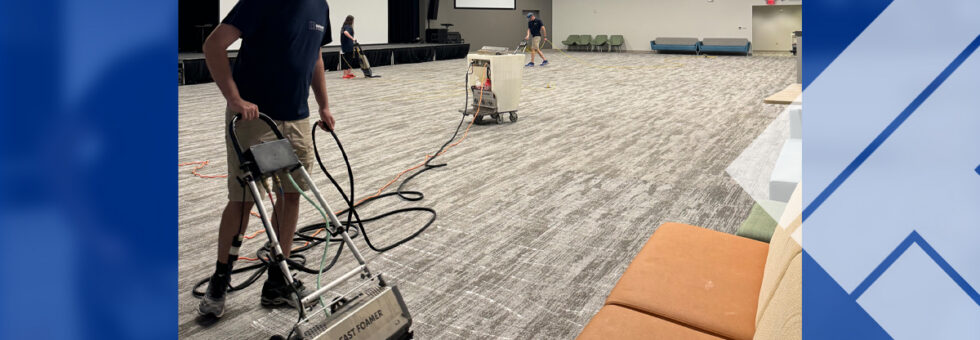
Interim cleaning can be performed using:
- Encapsulation extraction
- Low-moisture cleaning systems
- Dry compound systems
- Water rinse extraction
Yes, water rinse extraction can be an Interim cleaning method when used at the appropriate intensity and frequency to manage soluble soils without excessive disruption or over-wetting.
Interim cleaning is defined by three factors:
- Objective: maintaining uniform appearance and performance
- Intensity: greater than routine, lower than restorative
- Frequency: driven by soil load, traffic, and use, not tradition
Interim vs. Restorative Cleaning: The Only Difference Is Intensity
The defining difference between interim and restorative cleaning is intensity, not method.
Restorative (also called corrective or deep) cleaning is reactionary by design. It is intended to recover carpet that has exceeded normal maintenance capacity due to:
- Ineffective routine or interim care
- Unplanned events
- Extended neglect
Restorative cleaning is not defined by method either. It is defined by the level of intervention required.
The purpose of interim cleaning is to postpone or eliminate the need for restorative cleaning.
That relationship is foundational, not incidental.
Restorative (also called corrective or deep) cleaning is reactionary by design. It is intended to recover carpet that has exceeded normal maintenance capacity due to:
- Ineffective routine or interim care
- Unplanned events
- Extended neglect
Restorative cleaning is not defined by method either. It is defined by the level of intervention required.
The purpose of interim cleaning is to postpone or eliminate the need for restorative cleaning.
That relationship is foundational, not incidental.
Why “High Production” and “Return to Use” Are Not Limitations
Interim cleaning does not prioritize speed over effectiveness.
The phrase “high production and rapid return to use” simply reflects a commercial reality: occupied facilities must remain functional.
Regardless of strategy or method, the goal is always to return the floor to service as efficiently as possible. Speed is not the strategy. Appropriateness is.
The Bigger Picture: Commercial Carpet Is Not a One-Method System
A complete commercial carpet care system requires coordinated entrainment mechanisms:
- Air entrainment (vacuuming)
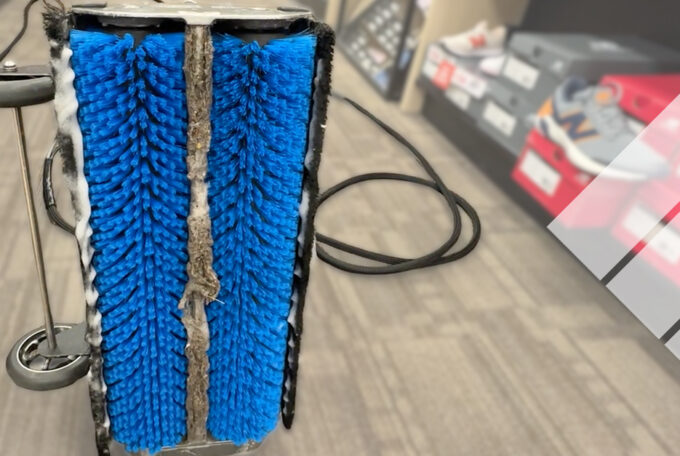
- Mechanical entrainment© (pile lifting or CRB systems)
- Water entrainment (rinsing or extraction when appropriate)
Interim cleaning is where mechanical and chemical actions are intentionally combined to manage soluble soils efficiently, often bundling chemistry and mechanics to restore appearance while supporting routine processes.
That is not a workaround.
It is proper system design.
The Plain Language Definition
Interim Cleaning is the strategy used to keep soluble soils and binding agents off the wear surface of commercial carpet so appearance remains uniform and routine vacuuming remains effective.
That’s it.
Not maintenance instead of cleaning.
Not low-moisture only.
Not a placeholder for restoration.
Just cleaning the soils that routine cleaning does not address, at the intensity required and no more.
Final Thought
When Routine and Interim strategies are executed correctly, restorative cleaning becomes a choice rather than a necessity.
When language aligns with soil physics and system design, standards do not need defending. They correct themselves.