5 Myths of Commercial Carpet Care and the Smarter Strategies Replacing Them
A Perspective for Carpet Manufacturers Reconsidering Their Maintenance Guidelines
In commercial environments, carpet care decisions are shaped largely by what manufacturers recommend. These guidelines carry weight – and for good reason. But as cleaning technologies evolve and expectations shift, it’s worth asking: Are today’s maintenance guidelines aligned with real-world performance?
We’re not suggesting manufacturer guidance is outdated or ineffective. In fact, many programs include low-moisture encapsulation systems as part of their interim maintenance cycle. But nearly all still recommend (if not require) periodic water rinse extraction (WRE) every 6 to 18 months as a restorative cleaning benchmark.
That’s the part we’re rethinking.
Here are five persistent myths still reflected in many care plans and the smarter strategies that could reshape how carpet performs in the field.
1. Myth: Water Rinse Extraction Is the Best Way to Clean Carpet
Water rinse extraction is deeply embedded in the industry. It’s supported by CRI lab testing, recommended by manufacturers and governing bodies, and it’s been the go-to method for decades. We understand why.
We’re not challenging its efficacy. We’re challenging its exclusivity. WRE has real limitations.It often introduces risk: longer dry times, wick-back, and rapid re-soiling. These aren’t just technician mistakes. They’re conditions built into the method itself.
More importantly, WRE doesn’t effectively remove the most damaging soil: the dry, embedded particulate tangled deep within the fiber. That’s the kind of soil that shortens the usable life of commercial carpet.
Smarter Strategy:
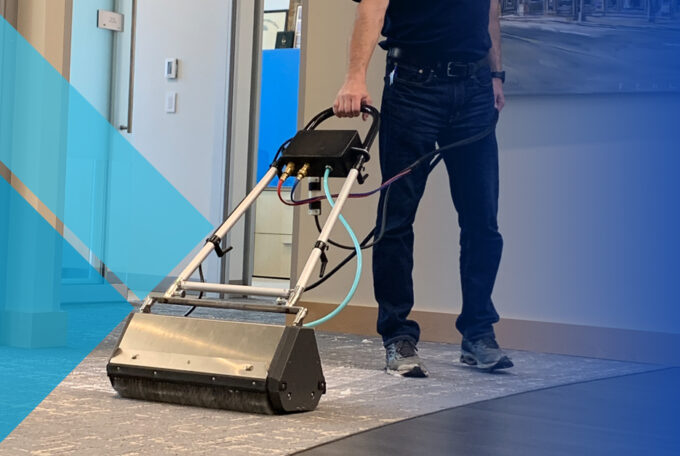
Any system – whether high or low-moisture – that incorporates CRB (counter-rotating brush) mechanical agitation will outperform traditional methods. CRBs dislodge and extract embedded dry particulate more effectively than vacuuming or water flushing alone. In practice, that means better results, less moisture, and fewer issues.
When more effective systems are used consistently, the need for WRE often fades, raising fair questions about its continued inclusion as a default requirement.
2. Myth: All Carpets Need the Same Care
Standardized recommendations may simplify care plans, but they don’t reflect the variability of real-world spaces. Soil loads, traffic, carpet construction, and environmental conditions differ dramatically from facility to facility.
Smarter Strategy:
Encourage adaptive care models. Maintenance plans should reflect how each space actually functions, not just follow one-size-fits-all specs that prescribe fixed frequencies or unnecessary methods. That means targeted, responsive cleaning built around soil conditions and performance goals, not default cycles.
3. Myth: Dirty Water Means Clean Carpet
Many assume that if water extracted from a carpet is visibly dirty, the cleaning was effective. But that logic doesn’t tell the full story. Dirty water simply confirms that some soil was removed, but not what type, how deeply it was embedded, or whether it affects long-term carpet performance.
In many cases, specifically when WRE occurs after low moisture encapsulation, what’s extracted is already loosened, encapsulated, or surface-level material – not the dry, embedded particulate that causes wear and degradation over time.
Smarter Strategy:
Shift success metrics toward what matters most: carpet that stays cleaner longer. Focus on long-term health, appearance retention, re-soiling resistance, and embedded soil reduction. Encapsulation systems that include CRB mechanical agitation are proven to reduce deep particulate load more effectively, helping carpet perform better between cleanings, not just immediately after.
4. Myth: Legacy Systems Still Set the Standard
Guidelines centered on WRE cycles and appearance outcomes often overlook what modern tools, advanced chemistry, and strategic cleaning methodologies can deliver. Encapsulation chemistry, CRB mechanical agitation, and proactive soil management offer more control, greater consistency, and reduced labor demands.
Smarter Strategy:
Support performance-first systems that reflect modern capabilities.
CRBs and advanced encapsulants don’t just clean more efficiently. They improve soil suspension, reduce operator fatigue, and enable faster re-entry times with fewer complaints. Unlike traditional methods, they minimize moisture risks while enhancing consistency across teams, shifts, and buildings. When paired with proactive soil management, these systems deliver cleaner carpet, longer performance cycles, and greater value at every stage of the maintenance plan.
5. Myth: Deep Cleaning Requires Water Rinse Extraction
Most guidelines still define deep cleaning by method, not by purpose. They assume that restorative cleaning is always needed every few cycles.
But here’s the truth: If routine and interim cleaning are effective, there’s nothing left to restore.
And yet, most manufacturer guidelines still recommend water rinse extraction as a required cycle for warranty compliance regardless of actual carpet condition. That means service providers and end users are being compelled to use a method that, while useful in specific situations, often introduces risk and disruption when applied routinely. In practice, this means a method is being mandated not by carpet condition, but by policy language. And when that method carries downsides like re-soiling, longer dry times, and wick-back, it’s fair to question whether this approach is actually serving the product or just the policy.
Smarter Strategy:
Stop prescribing “deep cleaning” (restorative) cycles by default. Define deep cleaning as effective soil removal regardless of method or tool. Water rinse extraction still has its place for greasy soils, heavy buildup, or specific environments. But when soil is consistently managed through mechanical CRB agitation, encapsulation, and dry removal, true deep cleaning becomes part of every maintenance event – not a separate, “restorative” cycle.
The Bigger Shift
Manufacturers may not always be incentivized to extend the life of their product indefinitely. But, here at Infinite, we are.
We’re focused on helping end users experience carpet the way it was designed to perform—for as long as possible.And that means challenging lingering commercial carpet cleaning myths.
Not because we’re pushing against the standard. But because we’re already operating where the standard should be.